
Scaling Professional Services Firms – A Framework for SLED Growth
In this day and age, with such uncertainty around federal funds flowing to states and local governments, scaling a professional services firm focused on the State, Local, and Education (SLED) market can be daunting. Firms are facing significant structural and market-related challenges that are impacting revenues, margins, and growth. One major hurdle is the difficulty of differentiating services in a highly competitive market. Many firms struggle to articulate a unique value proposition beyond cost or reputation, which makes it harder to win new business and often leads to the knee-jerk reaction to reduce fees. Margins begin to erode and before you know it, services and offerings have become commoditized.
Breaking out of a mode of price-driven commoditization requires growth-focused interventions aimed not only at winning new clients but also deepening relationships with existing ones. At the same time, firms must navigate pricing pressure from clients who increasingly demand more transparency, outcome-based billing, or lower-cost options. Balancing these client pressures with the need to maintain margins, expand into new markets and sub-markets, and keep pace with technological disruption creates a complex environment. Without clear specialization, strategic partnerships, or investments in innovation, many firms struggle to sustain consistent, profitable growth.
Achieving growth within this challenging environment requires, among other things a structured approach - incorporating those elements that directly impact a firm’s ability to scale. In the next section, we will highlight our structured framework for helping firms to scale.
The Strategic Growth Framework
To meet the challenge of how to scale within the current market and competitive challenges, we have developed a Framework for Strategic Growth that is designed to achieve the following six objectives:
- Shift from an exclusively reactionary opportunity identification mode into one that introduces strategic account coverage and proactive selling. Opportunistic pursuits still exist, but leadership is much more thoughtful about which ones to pursue.
- Improve response quality and closure rates
- Ensure that offerings/services are aligned with current and emerging market need; and that a set of “strategic” offerings are identified and supported.
- Maximize partnership opportunities across the sales, offering, and delivery ecosystems. This includes channels, solutions partners, and industry professional organizations.
- Increase brand recognition through a structured marketing and eminence campaign leveraging traditional channels as well as social media.
- Identify inorganic growth opportunities
This Strategic Growth Framework is illustrated below:
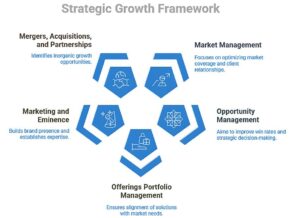
Let’s go through each of the Framework elements in a little more detail.
Market Management
Includes the sub-elements of Account Management, Market Segmentation and Prioritization, Alliances and Channels. The key objectives of Market Management are:
- Optimize coverage and client/prospect relationships;
- Focus coverage on the highest value clients and prospects;
- Create new sources of opportunities;
- Promote earlier identification of opportunities
- Promote earlier identification of client challenges and needs.
Opportunity Management
Includes how opportunities are sourced, validated, reviewed, and responded to. The key objectives of Opportunity Management are:
- Improve win/capture rates;
- Introduce a strategic view to bid/no-bid decisions;
- Improve ability to pursue larger opportunities.
Offerings Portfolio Management
Includes ensuring that the focus solutions/offerings are aligned to market needs. Within the entire existing portfolio of offerings, a subset of “focus” offerings are identified with will drive much of the proactive marketing and business development efforts. Key objectives of Offerings Portfolio Management are:
- Bring to market capabilities and offerings that are better aligned to client need;
- Achieve a "first mover" position with emerging market needs and challenges;
- Introduce a subset of industry-wide offerings, with investment, that accounts can sell.
Marketing and Eminence
Includes leveraging multiple branding and awareness channels as well as establishing the eminence of key firm leaders and subject experts. The key objectives of Marketing and Eminence are:
- Optimize allocation of marketing and branding $;
- Develop new opportunity sources;
- Establish the firm, and individuals, as experts in specific areas
Mergers, Acquisitions, and Partnerships
Includes the identification and evaluation of inorganic growth opportunities. The key Objectives of Mergers, Acquisitions, and Partnerships are:
- Source potential M&A candidates;
- Extend the firm's capabilities and offerings portfolios;
- Enter new sub-markets while strengthening presence in existing ones
What’s key to understand about the Strategic Growth Framework is that while it was designed to be used to develop a comprehensive market-driven strategy, individual components can be executed on, in modular fashion, to address acute issues in specific areas. For example, The Opportunity Management element has been deployed, individually, to assist with crafting a new process geared towards significant opportunities (versus “typical” ones that might enter the pipeline).
In the coming weeks, we will dive into each one of the five growth elements in more detail.
Some Additional Considerations
- The Strategic Growth Framework is designed to focus on increasing the top-line results (eg bookings and revenue) of a firm. Other areas that are critically important to the overall success of a firm – such as Talent Management, Pricing, and Delivery Excellence – are not addressed in this Framework.
- Much debate exists around the value of proactive selling by public sector-focused firms since the vast majority of procurements are competitive and driven by RFxs. Best-in-class firms take both approaches – a proactively-focused strategic account coverage model coupled with channels designed to capture opportunities in a reactive fashion.
- With reactive capture of opportunities, best-in-class firms end to be very judicious with those opportunities and have a structured process to evaluate competitiveness.
- Many firms have a social media content strategy that they execute regularly. In addition, many individual firm leaders also post content. However many firms do not coordinate the firmwide and individual actions. A significant opportunity exists to better coordinate what individuals are posting and writing about with what the firm is doing.